Showing posts with label Zvezda. Show all posts

Wednesday, January 5, 2022

Two New Cavalry Units

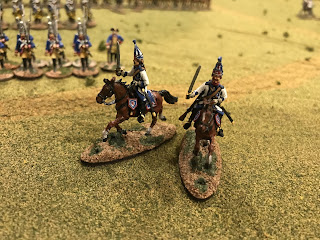
I finished two new cavalry units in January, one Allied, one French.  The first are the British 15th Light Horse also called Elliot’s Light Horse.  This unit was part of the Allied army commanded by Ferdinand of Brunswick and was made famous after its charge against the French at Emsdorf. The figures are from Italeri, US Independence War British Light Cavalry.  The uniforms are close to the ones worn during the Seven Years War and, in any case, the only set of cavalry wearing leather “jockey cap” type helmets available in1/72 plastic figures. 


The second unit are the French Bercheny Hussars.  This unit was part of Broglie’s army and was also present at Emsdorf where they were routed by Elliot’s Light Horse and Luckner’s Hussars.  The figures are from the excellent Zvezda set, Black Hussars of Frederick the Great.  The musician is from the Zevezda set Swedish Dragoons of Charles XII.  They are covering the right flank of the French advance and should see action soon.  


Friday, October 22, 2021

Update to Old School Rules

I have significantly revamped my Old School Rules.  The biggest change is resolving combat in groups instead of individual single combats.  Single combats became tedious and time consuming even for small actions.   I created new rules by modifying aspects of melee rules from Donald Featherstone and Charles Grant.  

The other change was updating the morale rules which were amended to a variation the one found in The Wargame by Charles Grant.  I wanted to have them reflect the impact of officer losses on command and control.  I also streamlined the overall rules and included more tables in place of long text explanations.  I did not materially change the rules for artillery and musket fire.

Overall, I'm pleased with how they work.  Here is the link for anyone interested.

Old School Rules 2021

Finally a pick of some of my latest old school figures.

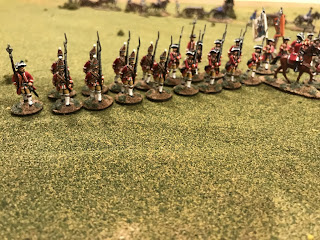
 Grenadiers from the Hanovarian Dragoons - Breidenbach Regiment


Hanovarian Infantry - Hardenberg Regiment


Five Allied Infantry Regiments:

    Hessian Grenadiers, Hessian Erbprinz, Hanovrian Von Scheither, British 4th King's Own, and Hanaovarian Hardenberg


Sunday, March 29, 2020

New Recruits

French dragoons, Apchon Regiment
Figures are Zvezda Swedish Dragoons.  The drummer and standard bearer are from the Zvezda Dragoons of Peter I.


Hessian infantry, the Erbprinz Regiment with grenadier company.  Always, wanted to have an Erbprinz regiment like Peter Young's in "Charge!" but because all my units are based upon historical units, I decided to go with a Hessian unit. 


A Bavarian howitzer battery.

Hanoverian 6 pounder battery.

French sapper unit.  Mix of Revell Austrian artillery figures and conversions of IMEX American Pioneers, with tricorn hats added.


Sunday, March 8, 2020

Reinforcements Arrive at Nindorf

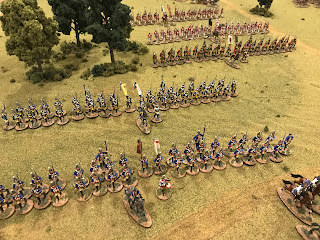
Two new units arrived to support the action near Bergen.  The Hereditary Prince calls up two squadrons of Brandenburg Cuirassiers to threaten the French left flank.

This unit was a conversion made from Zvezda Napoleonic Saxon Cuirassiers with heads swapped for Zvezda infantry heads wearing tricorn hats.  

The French commander, Saint-Germain, brings up a unit of Saxon infantry, Grenadier Battalion  Kurpinzessin.  Three companies wear new tricorn hats but the fourth is still in Mitre.  


Finally, French Dragoons (Zvezda GNW Swedish cavalry) (uniforms loosely based upon the Languedoc regiment) advance to challenge the Cuirassiers.


Wednesday, January 22, 2020

Nations, Real or Imagined

I have been working on building two mid eighteenth century armies to use with old school type rules, the ones highlighted in my last blog post.  While the various campaigns and battles between the “imaginations” of the Emperor and the Elector have been a primary inspiration for this project, this hobby has always been a vehicle for me to explore military history in greater detail.  The campaigns in Western Germany during the Seven Years War have always held special interest given the numerous states involved, the wide variety of uniforms, and the numerous engagements both big and small.

However, having decided to use 1/72 plastic figures to build these armies, compromises have had to be made given the lack of figures for many of the troop types prevalent during this period.  The goal has been to create units based on the actual units that may have fought in the War of Austrian Succession or Seven Years War.  In many cases, this has required a loose interpretation of the appropriate uniform details and the use of paint and conversions to create certain units.  The result so far has been a growing number of units based on actual historical battalions and regiments, even if some require a liberal dose of “imagination.”

The latest unit is based upon the French infantry regiment Conde.  The figures are from Zvezda Russian Infantry of Peter the Great.  The mounted officer is a modest conversion (pistol removed) of a figure from the Russian Dragoons of Peter I also by Zvezda.

Here is the entire unit, 32 musketeers in four companies of eight with additional officers, ensigns and musicians.


A close up of a company.


And a rear view of the same unit.


More to come.....

Sunday, December 15, 2019

How to Paint 1/72 Plastic Miniatures

I found a post in the Tips section of the Hat website many years ago that described a method of painting plastic figures so the paint won’t flake off even if handled roughly.  I have tried many methods posted on TMP - washing with soapy water, using spray primer designed for plastics etc. - and this is the only method that has worked for me.  I painted some Zvezda GNW Russians as SYW French, individually based for old school rules.

 First, trim figures and glue to craft sticks. I do not wash them.

Next, I coat with a craft glue, Aleene’s Tack-It Over and Over.  Coat figures thoroughly but sparingly
as to not lose the figures detail.  I let dry over night.  The glue, even when dry will remain sticky which helps form a strong bond between the paint and the figures.

Next, I prime the figures with either spray or brush on paint.


I then paint the figures and seal them with Liquitex Matt Varnish.  I base the figures individually on 18mm round Litko bases and flock.

Here’s a picture of the finished unit and finally a picture of how I store them.  As you can see, I just scoop them up and put them in a box.  The figures are very durable and do not chip.