Showing posts with label Terrain. Show all posts

Friday, December 17, 2021

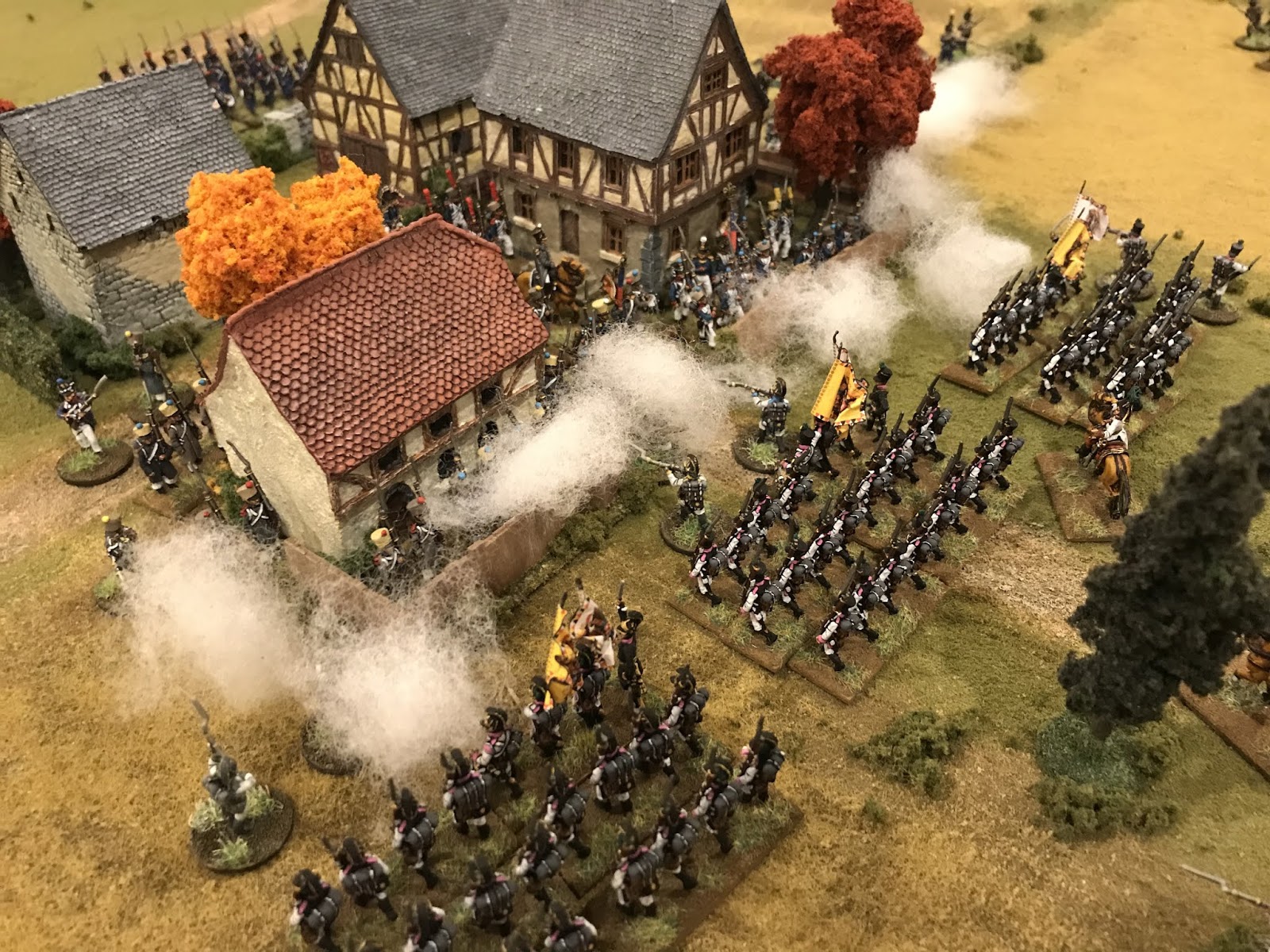
Scratch Built Buildings for Seven Years War

I was inspired to make some scratch built houses for my 1/72 scale 18th Century armies after viewing posts on TMP and blogs like Jimbibblyblog.  I tried to closely imitate some of the designs which I thought would be perfect for 18th century era houses.  I started by sketching the basic design including positions of doors and windows on 2mm chipboard sheets.  I then cut the pieces with an Exacto knife.
 

I glued the walls together and stabilized the joints with pieces of balsa wood.  


I then started to apply trim.  The exposed timber beams were made of 1/16th inch balsa wood strips.  The window sashes and door arches were either polystyrene plastic strips or thin card.

The timber strips and background were painted before being applied.  The stucco on the bottom half of the house was a thin application of AK hobby concrete.  


The windows and doors were installed before placing the roof.  The doors were scratch made and the windows are laser cut S scale windows purchased from Rail Scale Models.  The roof shingles shown below are also from Rail Scale.  Great products and great service from proprietor Steve Milley.   

The laser cut shingles are sold in sheets that can be cut into rows.  They were painted with a wash of dark gray paint before application.  After the roofing was finished, the shingles and timbers were dry brushed to give a weathered appearance.


Finished buildings in action.


Friday, December 18, 2020

Dolitz & Probstheyda, Leipzig - part 1

Something different, 18mm Napoleonics.  A scenario from the General de Brigade scenario book, volume 2.   This was featured in Wargames Illustrated, March 2001.  The scenario represents the fighting that took place in the southern sector on the third day of the Battle of Leipzig, October 18, 1813.  The French represent Augereau's IX Corp. Victor's II Corp, Oudinot's Guard Division and elements of Poniatowski's VIII Polish Corp.  The Allies, comprised of Austrian, Prussian and Russian divisions, are organized in two columns, the 1st Column under Hessen-Homberg and the 2nd Column under Barclay.  Here is the original map from the scenario booklet.    

This is a map I made to create the terrain, a similar area but showing the Pleisse River to the left of Dolitz and Lossnig.  Much fighting occurred around that river and I wanted it represented my scenario. 

Polish troops marching to take up positions in Dolitz. 


Dubreton’s division of Victor’s Corp advance to take defensive positions at Meusedorf Farm. 

Probstheyda, soon to be the scene of desperate fighting.

A view of Lossnig from across the Pleisse.  Dolitz in the background to the right.

Napoleon with entourage conferring with Marshall Victor.

The battle begins, two Austrian grenz battalions advance on Dolitz.


Bianchi’s Austrian’s begin advance on Dossen.


Silesian Uhlans attacking Semele’s division, supported by Austrian Uhlans.

Prussian fusiliers supported by landwehr advance on Muesdorf.


After the initial attack was repulsed, Austrian’s under Wimpfen attack Dolitz


Bordesoulle’s heavy cavalry division.  Saxon Cuirassiers and Garde du Corp in the lead followed by French Dragoons and Cuirassiers.

Russian Cuirassiers prepare to meet the threat.

Napoleon receives a report from Poniatowski near the tobacco mill.  

Augereau sends Lagarde’s division to reinforce Lossnig.


Austrian’s finally take Dolitz........


......and prepare to advance on Lossnig.
All figures are 18mm AB, some of the best miniatures in any scale.  Some units, all skirmishers and casualties we painted by me. Most of the rest were painted by Ron Redworth of Wargames Den in the UK.  Great painting and service.   More to come......


Thursday, March 5, 2020

Action Near Bergen

I set up a small action to test and refine my Old School Rules.  There terrain mat is scratch built using the method pioneered by WarArtisan, using housing caulk as an adhesive on a canvas and then pressing a variety of Woodland Scenics flock into it.  The method works great and I have made a number of different mats using this technique.  The houses are also scratch built.


The small battle was between the French and Allies circa 1759.   A blocking force led by the Hereditary Prince of Brunswick, consisted of two regular infantry battalions, a grenadier battalion, a light infantry unit, an artillery unit of two guns and two squadrons of hussars.  A French force led by Saint-Germain, had three infantry battalions, a unit of light infantry, a unit of artillery and two squadrons of dragoons.  His task was to clear the blocking force and secure the village of Nindorf, opening the route to Bergen for the Duc de Broglie.

                          The Hereditary Prince orders the Legion Britannique to secure the village.

The initial dispositions.  Allies in the foreground, Hanoverian infantry, Von Scheither on the left, British artillery in the center, British 4th (King’s Own) on the right with a Hessian Grenadier battalion in support.  Toward top of page in background are the French: Conde infantry and Gardes Francaises in line formation and a column of La Marine infantry advancing on the village.

View from the opposite side of the field, Conde infantry in the foreground, flanked by the Chasseurs de Fischer in the woods, facing the Von Scheither battalion.  

Here are closeups of the Chasseurs (in Mirliton), Gardes Francaises, and Conde infantry.


British artillery fire causes the first French casualties.  

Hanoverian’s take heavy casualties from the regulars and the Chasseurs....but the French are starting to feel the effects of close range artillery fire.

Legion Britannique rushes to meet Attack from La Marine infantry.

La Marine advances to take Nindorf.

The British and French engage in a firefight on the right flank of the village. Two squadrons of French Dragoons prepare to support different parts of the Attack. 

The Legion Britannique, who have not utilized the strong defensive position of the village, are suffering heavy casualties from the French Attack. 

A squadron of Prussian Von Ruesch hussars moves up to support the hard pressed Hanoverian light infantry.

The town’s refugees continue their flight.

More to come...............