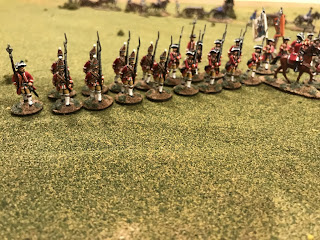
I set up a small action to test and refine my Old School Rules. There terrain mat is scratch built using the method pioneered by WarArtisan, using housing caulk as an adhesive on a canvas and then pressing a variety of Woodland Scenics flock into it. The method works great and I have made a number of different mats using this technique. The houses are also scratch built.
The small battle was between the French and Allies circa 1759. A blocking force led by the Hereditary Prince of Brunswick, consisted of two regular infantry battalions, a grenadier battalion, a light infantry unit, an artillery unit of two guns and two squadrons of hussars. A French force led by Saint-Germain, had three infantry battalions, a unit of light infantry, a unit of artillery and two squadrons of dragoons. His task was to clear the blocking force and secure the village of Nindorf, opening the route to Bergen for the Duc de Broglie.
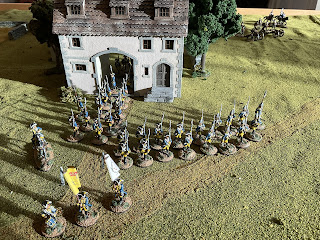
The Hereditary Prince orders the Legion Britannique to secure the village.
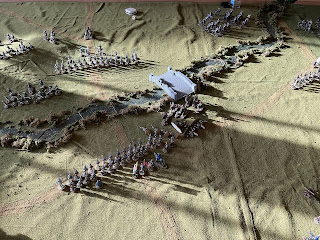
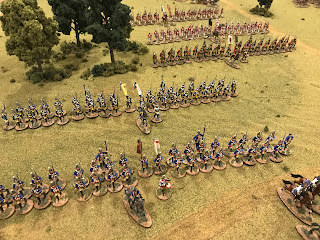
The initial dispositions. Allies in the foreground, Hanoverian infantry, Von Scheither on the left, British artillery in the center, British 4th (King’s Own) on the right with a Hessian Grenadier battalion in support. Toward top of page in background are the French: Conde infantry and Gardes Francaises in line formation and a column of La Marine infantry advancing on the village.
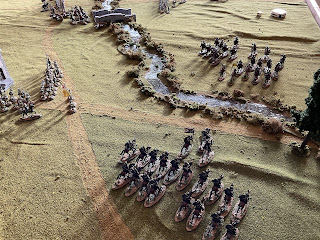
View from the opposite side of the field, Conde infantry in the foreground, flanked by the Chasseurs de Fischer in the woods, facing the Von Scheither battalion.
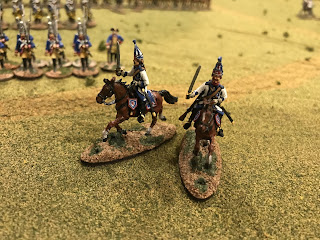
Here are closeups of the Chasseurs (in Mirliton), Gardes Francaises, and Conde infantry.

British artillery fire causes the first French casualties.
Hanoverian’s take heavy casualties from the regulars and the Chasseurs....but the French are starting to feel the effects of close range artillery fire.
Legion Britannique rushes to meet Attack from La Marine infantry.
La Marine advances to take Nindorf.
The British and French engage in a firefight on the right flank of the village. Two squadrons of French Dragoons prepare to support different parts of the Attack.
The Legion Britannique, who have not utilized the strong defensive position of the village, are suffering heavy casualties from the French Attack.
A squadron of Prussian Von Ruesch hussars moves up to support the hard pressed Hanoverian light infantry.
The town’s refugees continue their flight.
More to come...............